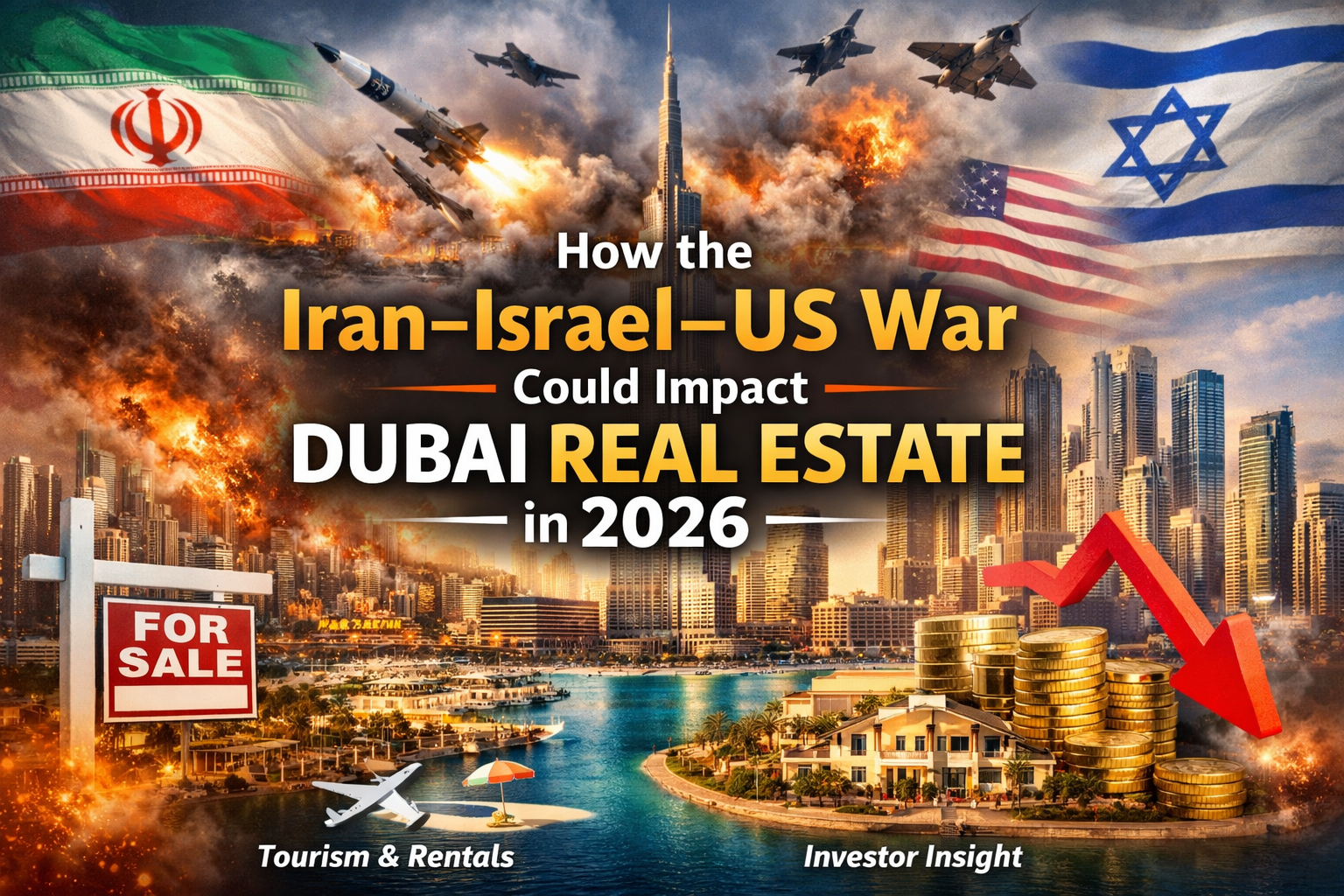
A detailed analysis of how the Iran–Israel–US conflict may impact Dubai real estate in 2026. Explore investor confidence, tourism, rental demand, luxury property trends, and the long-term outlook for property investors.
Market Analysis for Investors and Global Property Buyers
The Middle East has once again become the center of global geopolitical attention due to the escalating conflict involving Iran, Israel, and the United States. As tensions increase across the region, investors, expatriates, and global markets are closely watching how this conflict could affect economic hubs like Dubai.
Dubai has built its reputation as a global safe-haven city for investment, tourism, and luxury real estate. But with the conflict intensifying in 2026, many investors are asking an important question:
Will the war impact Dubai’s real estate market — or create new investment opportunities?
In this article, we analyze the short-term market reaction, investor confidence, tourism impact, luxury property demand, and the long-term outlook for Dubai real estate.
Short-Term Market Reaction
Financial markets typically react quickly to geopolitical uncertainty, and Dubai is no exception.
Recent reports show that Dubai’s financial markets and property sentiment have already experienced volatility following the escalation of the Iran-Israel-US conflict. Dubai’s main stock index fell as investors became more cautious due to regional instability and global economic uncertainty.
In the property sector, some investors have temporarily adopted a “wait-and-see” strategy, delaying purchases until the geopolitical situation becomes clearer.
Another sign of short-term market stress is the sharp decline in Dubai’s real estate index, which recently erased much of its gains for 2026 as the conflict intensified.
However, it is important to understand that short-term market reactions do not necessarily reflect long-term fundamentals.
Dubai’s real estate market has demonstrated resilience during previous global crises, including:
- The global financial crisis (2008)
- COVID-19 pandemic (2020)
- Regional geopolitical tensions
Historically, Dubai’s property market tends to recover quickly once uncertainty stabilizes.
Investor Confidence and Global Capital Flows
Dubai’s real estate market is heavily driven by international investors.
Over the past decade, the city has become one of the world’s most attractive destinations for property investment due to:
- Zero income tax
- Strong property ownership laws
- Long-term residency visas such as the Golden Visa
- High rental yields
These fundamentals remain intact in 2026.
Despite regional tensions, analysts note that Dubai’s property market is still supported by population growth, end-user demand, and strong capital inflows from global investors.
Dubai’s population surpassed 4 million residents in 2025, with hundreds of thousands of additional residents expected in the coming years.
Population growth is one of the strongest drivers of long-term housing demand.
However, geopolitical conflicts can temporarily affect investor psychology. When uncertainty rises:
- Some investors delay purchases
- Financing becomes more cautious
- Property transactions slow down temporarily
If the conflict continues for several weeks, analysts estimate 60–80% of currently delayed real estate deals could still close once stability returns.
This suggests that the slowdown may be temporary rather than structural.
Impact on Tourism and the Rental Market
Tourism is a key pillar of Dubai’s economy and plays a major role in the real estate market — especially for:
- Short-term rentals
- Airbnb investments
- Hotel apartments
- Holiday homes
However, the ongoing conflict has already caused significant disruption to tourism across the Middle East.
Industry estimates suggest the regional tourism sector is losing around $600 million per day due to cancelled flights, airspace closures, and travel concerns.
Dubai alone experienced tens of thousands of short-term rental cancellations in a single week, reflecting immediate concerns among travelers.
If the conflict continues, the following impacts could occur:
Possible Short-Term Effects
- Reduced tourist arrivals
- Lower Airbnb occupancy
- Temporary pressure on short-term rental yields
But There Is Also a Recovery Pattern
Dubai’s tourism industry has historically recovered quickly after global shocks.
Before the conflict escalated, Dubai welcomed over 18 million visitors annually, and tourism remains a key pillar of the city’s economy.
Once stability returns, travel demand usually rebounds strongly.
Impact on Luxury Property Buyers
Interestingly, the ultra-luxury segment of Dubai’s real estate market has remained extremely resilient.
Even during the ongoing geopolitical tensions, Dubai recorded one of the most expensive apartment sales in its history — worth approximately Dh422 million.
This demonstrates an important trend.
High-net-worth individuals often treat Dubai real estate as a wealth protection asset during uncertain times.
Reasons why wealthy investors continue to buy property in Dubai include:
- Political stability compared with many global cities
- Asset protection and capital preservation
- Luxury lifestyle and infrastructure
- Strong global connectivity
In many cases, geopolitical crises actually increase capital inflows into safe-haven markets like Dubai.
Long-Term Outlook for Dubai Real Estate
Despite short-term volatility, the long-term outlook for Dubai’s property market remains positive.
Several structural factors continue to support the market:
1. Population Growth
Dubai continues to attract professionals, entrepreneurs, and global investors.
2. Strong Rental Yields
Dubai offers some of the highest rental yields among global cities, often ranging between 6% and 10% depending on location and property type.
3. Government Policies
The UAE government continues to support the real estate market through:
- Long-term visas
- foreign ownership laws
- pro-investment policies
4. Global Wealth Migration
During geopolitical uncertainty, capital often flows to stable financial hubs, and Dubai has historically benefited from this trend.
However, analysts also warn that prolonged regional instability could test Dubai’s safe-haven image, particularly if the conflict escalates further.
What This Means for Property Investors
For investors, geopolitical crises can create both risks and opportunities.
Potential Risks
- Short-term market volatility
- Tourism disruptions
- Delayed property transactions
Potential Opportunities
- Temporary price corrections
- Less competition from speculative buyers
- Entry opportunities in prime areas
Savvy investors often use periods of uncertainty to acquire high-quality assets at better prices.
Final Thoughts
The Iran–Israel–US conflict has introduced a new layer of uncertainty across global markets, including Dubai real estate.
In the short term, the market may experience:
- cautious investor sentiment
- slower transaction activity
- temporary tourism disruptions
However, Dubai’s long-term fundamentals remain strong.
Population growth, international investment, strong rental yields, and government support continue to make Dubai one of the world’s most attractive real estate markets.
For long-term investors, the key question may not be whether Dubai will recover — but whether this period of uncertainty could create the next major investment opportunity.
Related Investment Guides
- Affordable Dubai Investment Areas (2026)
- Dubai Real Estate Market Forecast 2026
- Palm Jumeirah vs Dubai Marina: Best Dubai Property Investment in 2026?
- Dubai Rental Yields 2026: Highest ROI Areas for Property Investors
- Off-Plan Property in Dubai: Worth It in 2026?
- Dubai Property Costs Explained: All Fees Guide